
Documents Live, a web authoring and publishing system
Documents Live, a web authoring and publishing system
If you see this, something is wrong
First published on Saturday, Jul 6, 2024 and last modified on Thursday, Apr 10, 2025
Mathedu
In that paper, you will discover the complex numbers that correspond to vectors in the euclidean plane.
These numbers may be added, subtracted, multiplied and divided as the numbers they actually are.
We will discover the complex numbers as corresponding to the vectors given in the recapitulative document of the section 4 of the course, titled “The Canonical Vector Plane \( \mathbb{P}\) ”.

The complex numbers corresponding to the vectors drawn on figure 1 are described in the tables 1 below.
| Vector | Complex Number | Real Part | Imaginary Part |
| \( \overrightarrow{0}=\begin{bmatrix}0\\0\end{bmatrix}\) | \( z_0=0\) | \( \Re(z_0)=0\) | \( \Im(z_0)=0\) |
| \( \overrightarrow{i}=\begin{bmatrix}1\\0\end{bmatrix}\) | \( z_i=1\) | \( \Re(z_i)=1\) | \( \Im(z_i)=0\) |
| \( \overrightarrow{j}=\begin{bmatrix}0\\1\end{bmatrix}\) | \( z_j=i\) | \( \Re(z_j)=0\) | \( \Im(z_j)=1\) |
| \( \overrightarrow{v}_1=\begin{bmatrix}1\\1\end{bmatrix}\) | \( z_{v_1}=1+i\) | \( \Re(z_{v_1})=1\) | \( \Im(z_{v_1})=1\) |
| \( \overrightarrow{v}_2=\begin{bmatrix}-1\\1\end{bmatrix}\) | \( z_{v_2}=-1+i\) | \( \Re(z_{v_2})=-1\) | \( \Im(z_{v_2})=1\) |
| \( \overrightarrow{v}_3=\begin{bmatrix}-1\\0\end{bmatrix}\) | \( z_{v_3}=-1\) | \( \Re(z_{v_3})=-1\) | \( \Im(z_{v_3})=0\) |
| \( \overrightarrow{v}_4=\begin{bmatrix}-1\\{-1}\end{bmatrix}\) | \( z_{v_4}=-1-i\) | \( \Re(z_{v_4})=-1\) | \( \Im(z_{v_4})=-1\) |
| \( \overrightarrow{v}_5=\begin{bmatrix}0\\{-1}\end{bmatrix}\) | \( z_{v_5}=-i\) | \( \Re(z_{v_5})=0\) | \( \Im(z_{v_5})=-1\) |
| \( \overrightarrow{v}_6=\begin{bmatrix}1\\{-1}\end{bmatrix}\) | \( z_{v_6}=1-i\) | \( \Re(z_{v_6})=1\) | \( \Im(z_{v_6})=-1\) |
| \( \overrightarrow{u}_1=\begin{bmatrix}2\\0\end{bmatrix}\) | \( z_{u_1}=2\) | \( \Re(z_{u_1})=2\) | \( \Im(z_{u_1})=0\) |
| \( \overrightarrow{u}_2=\begin{bmatrix}2\\1\end{bmatrix}\) | \( z_{u_2}=2+i\) | \( \Re(z_{u_2})=2\) | \( \Im(z_{u_2})=1\) |
| \( \overrightarrow{u}_3=\begin{bmatrix}2\\2\end{bmatrix}\) | \( z_{u_3}=2+2i\) | \( \Re(z_{u_3})=2\) | \( \Im(z_{u_3})=2\) |
| \( \overrightarrow{u}_4=\begin{bmatrix}1\\2\end{bmatrix}\) | \( z_{u_4}=1+2i\) | \( \Re(z_{u_4})=1\) | \( \Im(z_{u_4})=2\) |
| \( \overrightarrow{u}_5=\begin{bmatrix}0\\2\end{bmatrix}\) | \( z_{u_5}=2i\) | \( \Re(z_{u_5})=0\) | \( \Im(z_{u_5})=2\) |
| \( \overrightarrow{u}_6=\begin{bmatrix}-1\\2\end{bmatrix}\) | \( z_{u_6}=-1+2i\) | \( \Re(z_{u_6})=-1\) | \( \Im(z_{u_6})=2\) |
| \( \overrightarrow{u}_7=\begin{bmatrix}-2\\2\end{bmatrix}\) | \( z_{u_7}=-2+2i\) | \( \Re(z_{u_7})=-2\) | \( \Im(z_{u_7})=2\) |
| \( \overrightarrow{u}_8=\begin{bmatrix}-2\\1\end{bmatrix}\) | \( z_{u_8}=-2+i\) | \( \Re(z_{u_8})=-2\) | \( \Im(z_{u_8})=1\) |
| \( \overrightarrow{u}_9=\begin{bmatrix}-2\\0\end{bmatrix}\) | \( z_{v_9}=-2\) | \( \Re(z_{v_9})=-2\) | \( \Im(z_{v_9})=0\) |
| \( \overrightarrow{u}_{10}=\begin{bmatrix}-2\\{-1}\end{bmatrix}\) | \( z_{u_{10}}=-2-i\) | \( \Re(z_{u_{10}})=-2\) | \( \Im(z_{u_{10}})=-1\) |
| \( \overrightarrow{u}_{11}=\begin{bmatrix}-2\\{-2}\end{bmatrix}\) | \( z_{u_{11}}=-2-2i\) | \( \Re(z_{u_{11}})=-2\) | \( \Im(z_{u_{11}})=-2\) |
| \( \overrightarrow{u}_{12}=\begin{bmatrix}-1\\{-2}\end{bmatrix}\) | \( z_{u_{12}}=-1-2i\) | \( \Re(z_{u_{12}})=-1\) | \( \Im(z_{u_{12}})=-2\) |
| \( \overrightarrow{u}_{13}=\begin{bmatrix}0\\{-2}\end{bmatrix}\) | \( z_{u_{13}}=-2i\) | \( \Re(z_{u_{13}})=0\) | \( \Im(z_{u_{13}})=-2\) |
| \( \overrightarrow{u}_{14}=\begin{bmatrix}1\\{-2}\end{bmatrix}\) | \( z_{u_{14}}=1-2i\) | \( \Re(z_{u_{14}})=1\) | \( \Re(z_{u_{14}})=-2\) |
| \( \overrightarrow{u}_{15}=\begin{bmatrix}2\\{-2}\end{bmatrix}\) | \( z_{u_{15}}=2-2i\) | \( \Re(z_{u_{15}})=2\) | \( \Re(z_{u_{15}})=-2\) |
| \( \overrightarrow{u}_{16}=\begin{bmatrix}2\\{-1}\end{bmatrix}\) | \( z_{u_{16}}=2-i\) | \( \Re(z_{u_{16}})=2\) | \( \Re(z_{u_{16}})=-1\) |
Note that the real part of a the complex number corresponding to a column vector is its first element, and the imaginary part of that complex number is its second element.
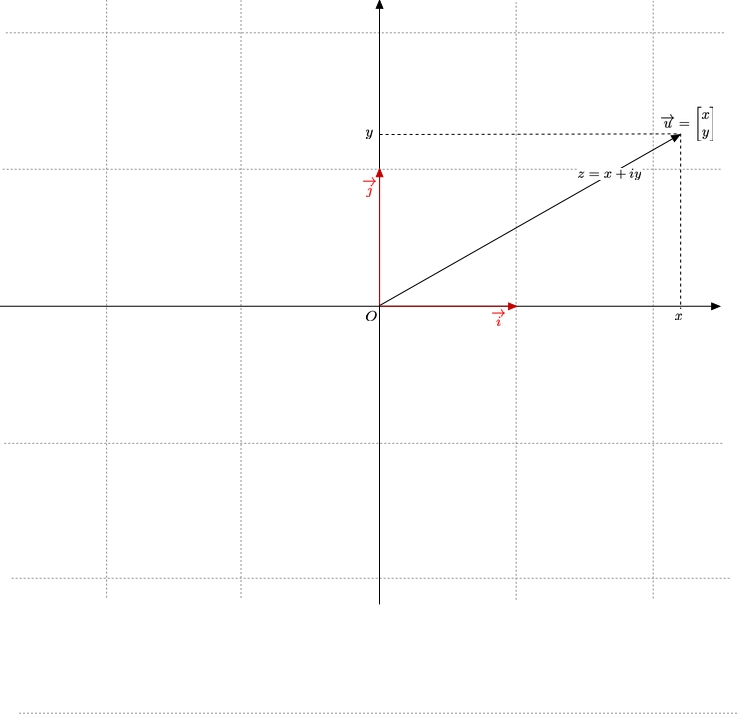
The vector \( \overrightarrow{u}=\begin{bmatrix}x\\y\end{bmatrix}\) , with abscissa \( x\) and ordinate \( y\) corresponds to the complex number \( z=x+iy\) , with real part \( \Re(z)=x\) and imaginary part \( \Im(z)=y\) .
Assume that \( (x,y)\in\mathbb{R}^2\) are real numbers, and consider the vector \( \overrightarrow{u}\in\mathbb{P}\) of cartesian coordinates \( x\) and \( y\) in the canonical basis \( (\overrightarrow{i},\overrightarrow{j})\) .
Then we know that \( \overrightarrow{u}=x\overrightarrow{i}+y\overrightarrow{j}\) .
Moreover, the complex number \( 1\) corresponds to the basis vector \( \overrightarrow{i}\) , and the complex number \( i\) corresponds to the basis vector \( \overrightarrow{j}\) .
Consequently, the complex number \( z\) that corresponds to the vector \( \overrightarrow{u}\) may be obtained by the following operations :
multiply \( x\) by \( 1\) , to obtain \( x\) ,
multiply \( y\) by \( i\) , to obtain \( iy\) ,
add \( x\) and \( iy\) , to obtain \( z=x+iy\) .
The complex numbers are available in numpy package, so that you have to type in front of your code:
from numpy import *A complex number is simply defined on the models
z1=3+2j
z2=4-1j
Note that the imaginary number \( i\) is denoted j in Python. It is the notation of the physics scientists.
Moreover, that number is not multiplied by the imaginary part, as there is no ‘*’ between them.
In particular, if the imaginary part is \( 1\) or \( -1\) , the ‘1’ in front of j is mandatory.
And finally, we may add, subtract, multiply and divide complex numbers in Python just as qe do with real numbers, on the models:
s=z1+z2
d=z1-z2
p=z1*z2
q=z1/z2The complex numbers may not only be considered as vectors in the euclidean plane.
They are also numbers and, as such, may be added, subtracted, multiplied and divided together.
The addition and subtraction of the complex numbers are the homolog operations on the vectors they correspond to.
Definition 1
Assume that \( (x_1,y_1,x_2,y_2)\in\mathbb{R}^4\) are real numbers, and consider the complex numbers \( z_{1}=x_{1}+iy_{1}\) and \( z_{2}=x_{2}+iy_{2}\) .
Then we define the sum and difference of \( z_{1}\) and \( z_{2}\) the following way:
\( z_1+z_2=(x_1+x_2)+i(y_1+y_2)\) ,
and \( z_1-z_2=(x_1-x_2)+i(y_1-y_2)\)
The multiplication of the complex numbers relies on the fact that, by definition of \( i\) , it is a square root of \( -1\) , i.e. \( i^{2}=-1\) .
The multiplication of complex numbers is considered as commutative, associative and distributive on the addition as is it in \( \mathbb{R}\) .
So the we may build the product of \( z_{1}=x_{1}+iy_{1}\) and \( z_{2}=x_{2}+iy_{2}\) the following way:
\( z_{1}z_{2}=(x_{1}+iy_{1})(x_{2}+iy_{2}) =x_{1}x_{2}+ix_{1}y_{2}+iy_{1}x_{2}+i^{2}y_{1}y_{2}\)
\( z_{1}z_{2}=(x_1x_2-y_1y_2)+i(x_1y_2+x_2y_1)\)
So that we may give the following definition of the multiplication of two complex numbers.
Definition 2
Assume that \( (x_1,y_1,x_2,y_2)\in\mathbb{R}^4\) are real numbers, and consider the complex numbers \( z_{1}=x_{1}+iy_{1}\) and \( z_{2}=x_{2}+iy_{2}\) .
Then we define the product of \( z_{1}\) and \( z_{2}\) the following way:
\( z_1z_2=(x_1x_2-y_1y_2)+i(x_1y_2+x_2y_1)\)
Proposition 1
Assume that \( (x,y)\in\mathbb{R}^2\) are real numbers, and consider the complex number \( z=x+iy\) . Then the following results hold:
\( 1\times z=z\times 1=z\) : \( 1\) is neutral for the multiplication of complex numbers.
\( (-1)\times z=z\times (-1)=-z\) , the opposite of \( z\) is defined as \( -z=-x-iy\) .
\( i\times z=z\times i=-y+ix\) .
\( (-i)\times z=z\times (-i)=y-ix\) .
Proof
Assume that \( (x,y)\in\mathbb{R}^2\) are real numbers, and consider the complex number \( z=x+iy\) .
Then we may use the definition 2 to perform the following calculations.
As \( 1=1+0\times i\) ,
\( 1\times z=(1\times x-0\times y)+i(1\times y+0\times x)=x+iy=z\) .
Moreover, \( z\times 1=(x\times 1-y\times 0)+i(x\times 0+y\times 1)=x+iy=z\) .
As \( -1=-1+0\times i\) and, by a convention consistent with the definition of the subtraction, \( i(-y)=-iy\) ,
\( (-1)\times z=((-1)\times x-0\times y)+i((-1)\times y+0\times x)=-x-iy=-z\) .
Moreover, \( z\times (-1)=(x\times (-1)-y\times 0)+i(x\times 0+y\times (-1))=-x-iy=-z\) .
As \( i=0+1\times i\) ,
\( iz=(0\times x-1\times y)+i(0\times y+1\times x)=-y+ix\) .
Moreover, \( iz=(x\times 0-y\times 1)+i(x\times 1+y\times 0)=-y+ix\) .
As \( -i=0+(-1)\times i\) and, by a convention consistent with the definition of the subtraction, \( i(-x)=-ix\) ,
\( (-i)\times z=(0\times x-(-1)\times y)+i(0\times y+(-1)\times x)=y-ix\) .
Moreover, \( z\times (-i)=(x\times 0-y\times (-1))+i(x\times (-1)+y\times 0)=y-ix\) .
The complex number \( 0\) is the real number \( 0\) and correxponds to the nul vector \( \overrightarrow{0}=\begin{bmatrix} 0\\0 \end{bmatrix}\) .
Proposition 2
Assume that \( (x,y)\in\mathbb{R}^2\) are real numbers, and consider the complex number \( z=x+iy\) .
Then the following assertions are equivalent to each other:
\( z\ne 0\)
\( x\) and \( y\) are not zero together.
\( x^{2}+y^{2}\ne 0\) .
The proposition is straightforward if we replace the complex number \( z=x+iy\) by the vector it corresponds to \( \overrightarrow{u}=\begin{bmatrix} x\\y \end{bmatrix}\) , and if we remember that \( \left\| \overrightarrow{u} \right\|=0\) if and only if \( \overrightarrow{u}=\overrightarrow{0}\) .
Proposition 3
Assume that \( (x,y)\in\mathbb{R}^2\) are real numbers, and consider the complex number \( z=x+iy\) .
Then there exists a complex number \( z'\) such that \( zz'=1\) if and only if \( z\ne 0\) .
Moreover, if \( z\ne 0\) , the complex number \( z'\) such that \( zz'=1\) is unique and is so that \( z'z=1\) .
And, always with \( z\ne 0\) , the complex number \( z'\) such that \( zz'=1\) , is equal to \( z'= \frac{x}{x^2+y^2}+i\frac{-y}{x^2+y^2}\) .
Definition 3
For any non zero complex number \( z\) , the complex number \( z'\) such that \( zz'=1\) is called the inverse of \( z\) , and is denoted \( z'=\frac{1}{z}\) .
Proof (of the proposition 3)
Assume that \( (x,y)\in\mathbb{R}^2\) are real numbers, and consider the complex number \( z=x+iy\) .
If \( z=0=0+i\times 0\) , then, for any complex number \( z'=x'+ iy'\) , \( zz'=(0\times x'-0\times y')+i(0\times y'+0\times x')=0\) , that can not be equal to \( 1\) .
Assume that \( z\ne 0\) , and let’s try to find a \( z'=x'+ iy'\) such that \( zz'=1=1+i\times 0\) .
This is equivalent to the system of linear equations in \( (x',y')\) :
\( \left\{ \begin{matrix} xx'-yy'=1\\ yx'+xy'=0 \end{matrix} \right. \)
That system is equivalent to the matrix equation \( AX=B\) , with the following definitions.
The unknown \( X\) is equal to to column vector \( X=\begin{bmatrix} x'\\y' \end{bmatrix}\) .
\( A\) i the square matrix \( A=\begin{bmatrix} x&-y\\y&x \end{bmatrix}\) .
The second member \( B\) is equal to to column vector \( B=\begin{bmatrix} 1\\0 \end{bmatrix}\) .
The determinant of the matrix \( A\) is equal to \( \det(A)=x^{2}+y^{2}\) , that is non zero because \( z\ne 0\) and the proposition 2.
Consequently, the matrix equation has a unique solotion in \( X=\begin{bmatrix} x'\\y' \end{bmatrix}\) :
\( X=A^{-1}B=\frac{1}{x^{2}+y^{2}}\begin{bmatrix} x&y\\{-y}&x \end{bmatrix}\begin{bmatrix} 1\\0 \end{bmatrix} =\begin{bmatrix} x\\{-y} \end{bmatrix}\) .
So that the unique solution of the system is \( (x',y')=(\frac{x}{x^2+y^2},\frac{-y}{x^2+y^2})\)
Consequently, there exists a unique \( z'\) such that \( zz'=1\) , and it is equal to \( z'= \frac{x}{x^2+y^2}+i\frac{-y}{x^2+y^2}\) .
Moreover, \( z'z\) has the following real and imaginary parts:
Its real part is \( \Re(zz')=x\frac{x}{x^2+y^2}+y\frac{y}{x^2+y^2}=\frac{x^2+y^2}{x^2+y^2}=1\)
Its imaginary part is \( \Im(zz')=x\frac{y}{x^2+y^2}-y\frac{x}{x^2+y^2}=\frac{xy-yx}{x^2+y^2}=0\)
Consequently, \( zz'=1+i\times 0=1\) .
Proposition 4
The following results hold:
\( \frac{1}{1}=1\) : the inverse of \( 1\) is itself.
\( \frac{1}{-1}=-1\) : the inverse of \( -1\) is itself.
\( \frac{1}{i}=-i\) : the inverse of \( i\) is its opposite.
\( \frac{1}{-i}=i\) : the inverse of \( -i\) is its opposite.
Proof
\( \frac{1}{1}=1\) because
\( 1\times 1=(1+i\times 0)\times(1+i\times 0) =(1\times 1-0\times 0)+i(1\times 0+0\times 1)=1\) .
\( \frac{1}{-1}=-1\) because
\( (-1)\times 1=((-1)+i\times 0)\times((-1)+i\times 0) =((-1)\times 1-0\times 0)+i((-1)\times 0+0\times (-1))=-1\) .
\( \frac{1}{i}=-i\) because
\( i\times (-i)=(0+i\times 1)\times(0+i\times (-1)) =(0\times 0-1\times (-1))+i(0\times (-1)+1\times 0)=1\) .
\( \frac{1}{-i}=i\) because
\( (-i)\times i=(0+i\times (-1))\times(0+i\times 1) =(0\times 0-(-1)\times 1)+i(0\times 1+(-1)\times 0)=1\) .
Definition 4
Assume that \( (x_1,y_1,x_2,y_2)\in\mathbb{R}^4\) are real numbers, and consider the complex numbers \( z_{1}=x_{1}+iy_{1}\) and \( z_{2}=x_{2}+iy_{2}\) such that \( z_{2}\ne 0\) .
Then we define the quotient of \( z_{1}\) and \( z_{2}\) as \( \frac{z_1}{z_2}=z_1\frac{1}{z_2}\) .
Proposition 5
Assume that \( (x_1,y_1,x_2,y_2)\in\mathbb{R}^4\) are real numbers, and consider the complex numbers \( z_{1}=x_{1}+iy_{1}\) and \( z_{2}=x_{2}+iy_{2}\) such that \( z_{2}\ne 0\) .
Then the quotient of \( z_{1}\) and \( z_{2}\) is equal to:
\( \frac{z_1}{z_2}=\frac{x_1x_2+y_1y_2}{x_2^2+y_2^2}+i\;\frac{-x_1y_2+x_2y_1}{x_2^2+y_2^2}\) .
Proof
Assume that \( (x_1,y_1,x_2,y_2)\in\mathbb{R}^4\) are real numbers, and consider the complex numbers \( z_{1}=x_{1}+iy_{1}\) and \( z_{2}=x_{2}+iy_{2}\) such that \( z_{2}\ne 0\) .
Then we may perform the following calculations:
\( \frac{z_1}{z_2}=z_1\frac{1}{z_2}=(x_{1}+iy_{1}) \left(\frac{x_{2}}{x_{2}^2+y_{2}^2}+i\frac{-y_{2}}{x_{2}^2+y_{2}^2}\right) =\frac{x_1x_2+y_1y_2}{x_2^2+y_2^2}+i\;\frac{-x_1y_2+x_2y_1}{x_2^2+y_2^2}\)
Proposition 6
Assume that \( (x,y)\in\mathbb{R}^2\) are real numbers, and consider the complex number \( z=x+iy\) . Then the following results hold:
\( \frac{z}{1}=z\) .
\( \frac{z}{-1}=-z\) .
\( \frac{z}{i}=-iz=y-ix\) .
\( \frac{z}{-i}=iz=-y+ix\) .
Proof
Assume that \( (x,y)\in\mathbb{R}^2\) are real numbers, and consider the complex number \( z=x+iy\) .
Then we may perform the following calculations, with the help of the propositions 1 and 4.
As \( \frac{1}{1}=1\) and \( z\times 1=z\) , then \( \frac{z}{1}=z\) .
As \( \frac{1}{-1}=-1\) and \( z\times(-1)=-z\) , then \( \frac{z}{-1}=-z\) .
As \( \frac{1}{i}=-i\) : and \( z\times(-i)=-y-ix\) , then \( \frac{z}{i}=-iz=y-ix\) .
As \( \frac{1}{-i}=i\) and \( z\times i=--y+ix\) , then \( \frac{z}{-i}=iz=-y+ix\) .
Let’s denote \( \mathbb{C}\) the set of all the complex numbers.
Let’s consider any real number \( x\in\mathbb{R}\) as the complex number \( x+i\times0\) , with real part \( x\) and with imaginary part \( 0\) .
Proposition 7
The addition, subtraction, multiplication and division of complex numbers restrict to the real numbers as they act in \( \mathbb{R}\) .
Proof
Assume that \( (x_{1},x_{2})\in\mathbb{R}^{2}\) are real numbers, and consider the equivalent complex numbers \( z_{1}=x_{1}+i\times0\) and \( z_{2}=x_{2}+i\times0\) .
Then we may perform the following calculations.
\( z_{1}+z_{2}=(x_{1}+x_{2})+i(0+0)=x_{1}+x_{2}\)
\( z_{1}-z_{2}=(x_{1}-x_{2})+i(0-0)=x_{1}-x_{2}\)
\( (z_{1}z_{2}=(x_{1}x_{2}-0\times 0)+i(x_{1}\times 0+x_{2}\times 0)=x_{1}x_{2}\)
\( \frac{z_1}{z_2}=\frac{x_1x_2+0\times 0}{x_2^2+0^2} +i\;\frac{-x_1\times 0+x_2\times 0}{x_2^2+0^2} =\frac{x_1x_2}{x_2^2}+i\times 0=\frac{x_1}{x_2}\)
We shall prove in the Lecture 64 about the field of complex numbers that \( (\mathbb{C},+,\times)\) is a commutative field.
Moreover, because of the proposition 7, \( (\mathbb{R},+,\times)\) is a subfield of \( (\mathbb{C},+,\times)\) .
The module and argument of a non zero complex number are the polar coordinates of the corresponding (non zero) vector.
Definition 5
Assume that \( (x,y)\in\mathbb{R}^2\) are real numbers that are not zero together, and consider the non zero complex number \( z=x+iy\) .
Then the module of \( z\) is defined as \( R=\left| z \right|=\sqrt{x^2+y^2}\) .
Assume that the polar angle of the corresponding vector to \( z\) is \( \theta\) .
Then \( \theta\) is called the argument of \( z\) . (It is defined modulo \( 2\pi\) ).
Proposition 8
Assume that \( (x,y)\in\mathbb{R}^2\) are real numbers that are not zero together, and consider the non zero complex number \( z=x+iy\) .
Assume that \( \left| z \right|=R\) and that the argument of \( z\) is \( \theta\) .
Then \( z=R(\cos(\theta)+i\sin(\theta))\) .
So that \( x=R\cos(\theta)\) and \( y=R\sin(\theta)\) .
Let’s define the function:
\( \begin{matrix} \exp_i:&\mathbb{R}&\rightarrow&\mathbb{C}\\ &\theta & \mapsto &\exp_{i}(\theta)=\cos(\theta)+i\sin(\theta) \end{matrix}\)
Proposition 9
For any real numbers \( (\theta_1,\theta_2)\in\mathbb{R}^2\) , we have \( \exp_{i}(\theta_1+\theta_2)=\exp_{i}(\theta_1)\exp_{i}(\theta_2)\) .
For that reason, and for other reasons beyond the scope of that course, we may enonciate the following definition.
Definition 6
For any real number \( \theta\in\mathbb{R}\) , \( \exp_{i}(\theta)=\cos(\theta)+i\sin(\theta)\) is the exponential of \( i\theta\) and is denoted \( \exp(i\theta)=\cos(\theta)+i\sin(\theta)\) .
It is also the number \( e\simeq 2.7\) to the power \( i\theta\) , that is denoted \( e^{i\theta}=\cos(\theta)+i\sin(\theta)\) .
Proof (of the proposition 9)
Assume that \( (\theta_1,\theta_2)\in\mathbb{R}^2\) are real numbers.
Then we may use the definition of the multiplication of complex numbers and the trigonometric formulae to perform the following calculations.
\( \exp_{i}(\theta_1)\exp_{i}(\theta_2) =(\cos(\theta_{1})+i\sin(\theta_{1}))(\cos(\theta_{2})+i\sin(\theta_{2}))\)
\( =(\cos(\theta_{1})\cos(\theta_{2})-\sin(\theta_{1})\sin(\theta_{2})) +i(\cos(\theta_{1})\sin(\theta_{2})+\sin(\theta_{1})\cos(\theta_{2}))\)
\( =\cos(\theta_{1}+\theta_{2})+i\sin(\theta_{1}+\theta_{2}) =\exp_{i}(\theta_1+\theta_2)\)
Assume that \( z\in\mathbb{C}^*\) is a non-zero complex number, and assume that its module is \( R\) , and its argument is \( \theta\) .
Then \( z=R(\cos(\theta)+i\sin(\theta))\) , so that the following exponential notation is valid:
\( z=Re^{i\theta}\)
Proposition 10
The module of the product of two non-zero complex numbers is the product of their modules.
And the argument of the product of two non-zero complex numbers is the sum of their arguments, modulo \( 2\pi\) .
Proof
Assume that \( (z_1,z_2)\in(\mathbb{C}^*)^2\) are non-zero complex numbers, and assume that \( z_1=R_1e^{i\theta_1}\) and \( z_2=R_2e^{i\theta_2}\) .
Then the following assertions hold:
\( z_{1}=x_{1}+iy_{1}\) , with \( x_{1}=R_{1}\cos(\theta_{1})\) and \( y_{1}=R_{1}\sin(\theta_{1})\) .
\( z_{2}=x_{2}+iy_{2}\) , with \( x_{2}=R_{2}\cos(\theta_{2})\) and \( y_{2}=R_{2}\sin(\theta_{2})\) .
Then we may use the definition of the multiplication of complex numbers and the trigonometric formulae to perform the following calculations.
\( z_{1}z_{2}=(x_{1}x_{2}-y_{1}y_{2})+i(x_{1}y_{2}+x_{2}y_{1})\)
\( =(R_{1}\cos(\theta_{1}))R_{2}\cos(\theta_{2})-R_{1}\sin(\theta_{1})R_{2}\sin(\theta_{2})) +i(R_{1}\cos(\theta_{1}R_{2}\sin(\theta_{2})+R_{1}\sin(\theta_{1})R_{2}\cos(\theta_{2}))\)
\( =R_{1}R_{2}(\cos(\theta_{1})\cos(\theta_{2})-\sin(\theta_{1})\sin(\theta_{2})) +iR_{1}R_{2}(\cos(\theta_{1})\sin(\theta_{2})+\sin(\theta_{1})\cos(\theta_{2}))\)
\( =R_{1}R_{2}\cos(\theta_{1}+\theta_{2})+iR_{1}R_{2}\sin(\theta_{1}+\theta_{2})\)
Consequently, \( z_{1}z_{2}\) corresponds to the vector
\( \overrightarrow{u}=\begin{bmatrix} R_{1}R_{2}\cos(\theta_{1}+\theta_{2})\\R_{1}R_{2}\sin(\theta_{1}+\theta_{2}) \end{bmatrix}=R_{1}R_{2}\begin{bmatrix} \cos(\theta_{1}+\theta_{2})\\\sin(\theta_{1}+\theta_{2}) \end{bmatrix}\) ,
with polar coordinates \( R_{1}R_{2}\) and \( \theta_{1}+\theta_{2}\) .
So that the module of \( z_{1}z_{2}\) is \( R_{1}R_{2}\) and its argument is \( \theta_{1}+\theta_{2}\) modulo \( 2\pi\) .
Proposition 11
Assume that \( \theta\in\mathbb{R}\) is a real number, and that \( k\in\mathbb{Z}\) is an integer.
Then the following assertions hold.
\( e^{2ik\pi}=1\)
\( e^{i(\pi+2k\pi)}=-1\)
\( e^{i(\frac{\pi}{2}+2k\pi)}=i\)
\( e^{i(-\frac{\pi}{2}+2k\pi)}=-i\)
Proof
Assume that \( \theta\in\mathbb{R}\) is a real number, and that \( k\in\mathbb{Z}\) is an integer.
Then we may perform the following calculations:
\( e^{2ik\pi}=\cos(2k\pi)+i\sin(2k\pi)=1+i\times 0=1\)
\( e^{i(\pi+2k\pi)}=\cos(\pi+2k\pi)+i\sin(\pi+2k\pi)=-1+i\times 0=-1\)
\( e^{i(\frac{\pi}{2}+2k\pi)}=\cos\left(\frac{\pi}{2}+2k\pi\right)+i\sin\left(\frac{\pi}{2}+2k\pi\right) =0+i\times 1=i\)
\( e^{i(-\frac{\pi}{2}+2k\pi)}=\cos\left(-\frac{\pi}{2}+2k\pi\right)+i\sin\left(-\frac{\pi}{2}+2k\pi\right) =0+i\times (-1)=-i\)
Proposition 12
Assume that \( (\theta,\mu)\in\mathbb{R}^{2}\) are real numbers.
Then the following assertions hold.
\( e^{i(\theta+\mu)}=e^{i\theta}e^{i\mu}\)
\( e^{i(\theta-\mu)}=\frac{e^{i\theta}}{e^{i\mu}}\)
\( \frac{1}{e^{i\theta}}=e^{-i\theta}\)
\( \frac{1}{e^{-i\theta}}=e^{i\theta}\)
Proof
Assume that \( (\theta,\mu)\in\mathbb{R}^{2}\) are real numbers.
Then \( e^{i\theta}=x_{\theta}+iy_{\theta}\) , with \( x_{\theta}=\cos(\theta)\) and \( y_{\theta}=\sin(\theta)\) .
And \( e^{i\mu}=x_{\mu}+iy_{\mu}\) , with \( x_{\mu}=\cos(\mu)\) and \( y_{\mu}=\sin(\mu)\) .
Then we may perform the following calculations.
\( e^{i\theta}e^{i\mu} =(\cos(\theta)\cos(\mu)-\sin(\theta)\sin(\mu))+i(\cos(\theta)\sin(\mu)+\sin(\theta)\cos(\mu))\)
\( =\cos(\theta+\mu)+i\sin(\theta+\mu) =e^{i(\theta+\mu)}\)
\( \frac{e^{i\theta}}{e^{i\mu}} =\frac{cos(\theta)\cos(\mu)+\sin(\theta)\sin(\mu)}{\cos^2(\mu)+\sin^{2}(\mu)}) +i\;\frac{-\cos(\theta)\sin(\mu)+\sin(\theta)\cos(\mu)}{\cos^2(\mu)+\sin^{2}(\mu)}\)
\( =\cos(\theta-\mu)+i\sin(\theta-\mu) =e^{i(\theta-\mu)}\)
\( \frac{1}{e^{i\theta}} =\frac{e^{i\times 0}}{e^{i\theta}} =e^{(0-\theta)}=e^{-i\theta}\)
\( \frac{1}{e^{-i\theta}} =\frac{e^{i\times 0}}{e^{i(-\theta)}} =e^{(0-(-\theta))}=e^{i\theta}\)
The complex exponential (and the \( \pi\) number) are aavailable in numpy package, so that you have to type in front of your code:
from numpy import *A complex exponential is the simple function èxp’, that stands for the real numbers too.
print('exp(i pi/3)=',exp(1j*pi/3))The function èxp’ is also valid for vectors, where it is executed element by element.
theta=arange(0,7)*pi/3
	# The integers from 0 to 6 (7 is excluded), multiplied
	# element by elament by pi/3:
	# The real numbers from 0 to 6pi/3=2pi, by steps of pi/3.

	z=exp(1j*theta)
	# The exponential of i*theta, element by element.
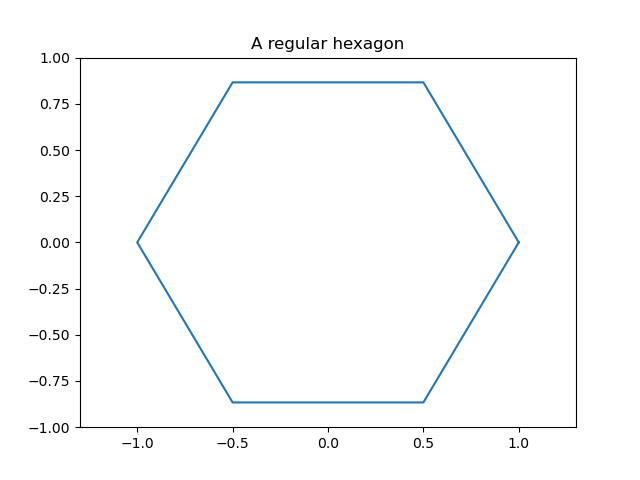
The complex numbers in the vector ‘z’ correpond to the unit vectors in the plane that make an angle \( \frac{\pi}{3}\) from one vector to the next one, and that turn form the vector \( \overrightarrow{i}\) to the same vector back.
As \( \frac{\pi}{3}=\frac{2\pi}{6}\) , the unit vectors split th unit circle into 6 equal parts, so that they are the vertices of a regular hexagon.
To draw that hexagon, here is the script:
# Real parts and imaginary parts of the elements of the vector z
	x=real(z)
	y=imag(z)

	figure()
	plot(x,y)
	xlim(-1.3,1.3)
	ylim(-1,1)
	title('A regular hexagon')
The result is the following figure with an hexagon.
And now, we shall discover that a rotation in the euclidean plane corresponds to the multiplication by a complex number. That will allow an alternate straightforward proof of the properties of the rotations.
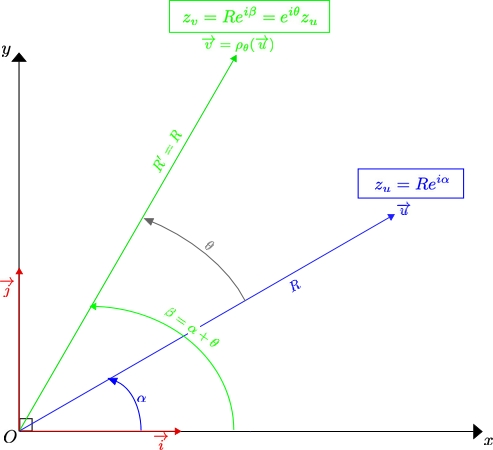
Assume that \( \overrightarrow{u}\in\mathbb{P}^*\) is a non-zero vector that corresponds to the non zero complex number \( z_u=Re^{i\alpha}\) .
Assume that \( \overrightarrow{v}\in\mathbb{P}^*\) is the non-zero vector \( \overrightarrow{v}=\rho_{\theta}(\overrightarrow{u})\) , and that it corresponds to the non zero complex number \( z_v=R'e^{i\beta}\) .
Then, as \( R'=R\) and \( \beta=\alpha+\theta\) , we have:
\( e^{i\theta}z_u=e^{i\theta}\times Re^{i\alpha}=Re^{i(\theta+\alpha)}=R'e^{i\beta}=z_{v}\) .
This is also true for the null vector, corresponding to \( 0\) in \( \mathbb{C}\) , because:
\( \rho_{\theta}(\overrightarrow{0})=\overrightarrow{0}\) ,
and \( e^{i\theta}\times\; 0=0\) .
Consequently, the rotation of angle \( \theta\) in the euclidean plane corresponds to the multiplication by \( e^{i\theta}\) in \( \mathbb{C}\) .
Note that the module of \( e^{i\theta}\) is equal to \( 1\) , and its argument is the angle \( \theta\) of the rotation.
The following properties of the rotations in the euclidean plane are now straightforward.
The rotation \( \rho_0\) is the identity application, because \( e^{i\times 0}=\cos(0)+i\sin(0)=1\) .
The rotation \( \rho_{\pi}\) transforms a vector in its opposite, because \( e^{i\pi}=\cos(\pi)+i\sin(\pi)=-1\) .
For any real number \( \theta\in\mathbb{R}\) , the application \( \rho_{\theta}\) is one-to-one and its inverse is \( \rho_{\theta}^{-1}=\rho_{(-\theta)}\) , because \( \frac{1}{e^{i\theta}}=e^{-i\theta}\) .
For any real numbers \( (\theta,\mu)\in\mathbb{R}^2\) , \( \rho_{\theta}\circ\rho_{\mu}=\rho_{(\theta+\mu)}\) , because \( e^{i\theta}e^{i\mu}=e^{i(\theta+\mu)}\) .
We discovered in that paper that the vectors in the euclidean plane may be modelized as the so called complex numbers, with:
The cartesian coordinates corresponding to the real part and the imaginary part.
The addition and subtraction of vectors corresponding to the homolog operations between complex numbers.
The polar coordinates of the non zero vectors corresponding to the module and argument of the complex numbers.
The rotation of angle \( \theta\) in the euclidean plane corresponding to the multiplication of the complex numbers by the complex exponential \( e^{i\theta}\).